
Bowl Segment Calculator Tool
Overview: Calc-Tools Online Calculator offers a free platform for various scientific and utility calculations. Its Bowl Segment Calculator is a specialized tool designed for woodworkers engaged in segmented woodturning. This craft involves cutting and gluing wooden segments into rings, which are then stacked to form a bowl blank for lathe turning. The calculator assists by providing precise measurements and cutting angles for these segments, allowing crafters to focus on their artistry while it handles the complex mathematics. The accompanying article explains segmented woodturning, details how to use the calculator, and covers fundamental calculation methods for creating beautiful segmented wooden bowls.
Master the Art of Segmented Wood Bowls
Crafting stunning segmented wood bowls requires precise measurements and angles. This free online calculator tool eliminates the guesswork, providing you with the exact calculations needed to cut your wooden segments perfectly. Focus on honing your woodturning craft while we handle the complex mathematics behind the scenes. Discover how to transform simple boards into beautiful, ring-constructed bowls.
This guide will walk you through the essential knowledge for segmented bowl turning. You will learn the fundamentals of this woodworking technique and how to effectively use our scientific calculator. We will also cover the key calculations and answer common questions to ensure your project's success.
Understanding Segmented Wood Turning
The term "segmented" refers to the process of gluing individually cut wood pieces together to form a ring. Multiple rings are then stacked and glued to create the rough form of a bowl. This assembly, combined with a solid base, is mounted on a lathe for final turning and shaping. The final product is a beautifully crafted segmented wood bowl, showcasing the intricate pattern of joined segments.
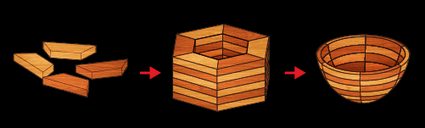
Next, let's explore how to use this specialized bowl segment calculator to start planning your first project.
How to Utilize the Bowl Segment Calculator
Our free calculator is designed for simplicity, requiring only a few key details about your planned bowl. Follow these steps to get accurate segment dimensions.
First, input your chosen number of segments for each ring. A minimum of three segments is required. Using more segments creates a smoother circle but involves cutting and managing smaller, more precise pieces.
Next, specify your target bowl's outer radius and wall thickness. You may also enter the inner ring radius. For those who prefer working with diameters, a simple checkbox reveals fields for outer and inner diameter inputs. This option also displays helpful reference values like interior angles and circumferences.
If you are new to this craft, adding a small "fudge factor" or allowance to the segment thickness can provide a safety margin against carving too deeply. You can apply this allowance to the inner side, outer side, or both sides of your segments.
Instantly, the tool will display all necessary wood segment dimensions. This includes the inner and outer side lengths, the required segment thickness, and the critical cutting angle for your miter saw or protractor. Remember to use the calculator separately for each distinct layer of your bowl, especially if the diameter changes throughout its height.
Performing Segmented Wood Bowl Calculations Manually
Our free scientific calculator uses established formulas to determine segment dimensions. Here’s a brief overview of the key equations, should you wish to understand or perform the math yourself.
The process begins by finding the interior angle (θ) for each segment. This is calculated by dividing 360 degrees by your number of segments (n):
θ = 360° / nThe cutting angle (α), which you set on your saw, is half of this interior angle:
α = 180° / nThis angle is also the miter angle where two segments meet.
Using trigonometry, the outer length (Lo) of a segment can be found with:
Lo = 2 × tan(180°/n) × (Ro + ao)where Ro is the outer radius and ao is the outer allowance.
Similarly, the inner length (Li) is calculated by:
Li = 2 × sin(180°/n) × (Ri - ai)where Ri is the inner radius and ai is the inner allowance. The inner and outer radii are related by the ring thickness (Tr):
Ri = Ro - TrFinally, the required thickness (Ts) of the wood board for your segments is:
Ts = (Ro + ao) - cos(180°/n) × (Ri - ai)To use diameters, simply substitute radius values with diameter/2 in these formulas. Circumference for any layer is found by multiplying its diameter by pi (π).
Frequently Asked Questions
What is the basic formula for segmented wood bowls?
The fundamental formula determines the cutting angle: α = 180° / n, where 'α' is the cutting angle and 'n' is the number of segments. The segment's outer length (L) can then be approximated by L = D × tan(α), where 'D' is the bowl's outer diameter.
What is the cutting angle for a bowl with 9 segments?
For a 9-segment bowl, the cutting angle is 20 degrees. This is derived from the formula: 180° divided by 9 segments equals 20°.
How do I calculate the segment thickness?
For example, to find the thickness for a bowl with a 10-inch outer diameter (5-inch radius), a 0.5-inch wall thickness, and 8 segments: First, find the cutting angle: 180° / 8 = 22.5°. The inner radius is 5" - 0.5" = 4.5". Then, apply the formula: Thickness = Outer Radius - cos(α) × Inner Radius. So, Thickness = 5 - cos(22.5°) × 4.5 ≈ 0.843 inches.
What is a common bowl diameter?
Typical dining bowls range from 9 to 10 inches in diameter. Sizes can vary from small 6-inch bowls to large serving bowls over 13 inches in diameter.